









Breast Cancer Stages Explained Simply (2025 Guide)
Whenever a family member is told, “You have breast cancer,” one of the next questions asked is always: “What stage is it?”
The stage of breast cancer is among the most significant aspects that determine the treatment and the outcome. In fact, the whole explanation from the doctor can be quite hard to digest. Such words as in situ, invasive, lymph nodes, and metastasis not only scare but also confuse patients and their families.
This guide explains breast cancer stages step by step, in simple language. Finally, you will understand what each stage means, along with common symptoms, how doctors decide on the treatment, and what survival rates look like thus, you will be able to have meaningful discussions with your healthcare team.
Related reading to explore afterward:
What Does “Staging” Mean in Breast Cancer?
Staging is the classification of the extent of cancer spread in the body by medical means. It specifies the details of the main tumor, lymph nodes, and metastasis, i.e., whether the cancer has spread to distant parts of the body.
- Tumor (T): What is the size of the main tumor?
- Nodes (N): Has the cancer been extended to the adjacent lymph nodes?
- Metastasis (M): Has the cancer spread to far-off areas of the body?
Then doctors combine this TNM system with other factors (hormone receptor status, HER2 status, tumor grade) to allocate a stage ranging from 0 to IV.
Two patients with tumors of the same size may still be very different in terms of treatment that is why this system is so important. Based on lymph node involvement or metastasis, staging is the determining factor. It also permits doctors to assess treatment efficacies and the survival rates in clinical trials.
Stage 0 Breast Cancer (Carcinoma in Situ)
Stage 0 breast cancer is the earliest form of non-invasive type. The abnormal cells are still inside the milk ducts or lobules of the breast and have not been released into neighboring tissue. At this point, the stage works as a “warning sign” that cancer can become invasive if not properly treated.
Types
- DCIS (Ductal Carcinoma in Situ): The abnormal cells are only in the milk duct lining. As a whole, DCIS is not a direct cause of death, but it has the potential to progress into invasive cancer if left untreated.
- LCIS (Lobular Carcinoma in Situ): Abnormal cells are in the lobules. LCIS is not actually cancer, but is referred to as a marker for getting breast cancer in both breasts in the future.
Symptoms
Most people affected by Stage 0 breast cancer do not feel anything physically. A regular mammogram that reveals minuscule white specks (microcalcifications) is the way through which it is typically noticed. Infrequently, there may be a little nipple discharge, but in general, it is quiet.
Diagnosis Tools
- Mammogram: Identifies microcalcifications (tiny clusters of calcium).
- Biopsy: Finds out if there are abnormal cells and also checks the hormone receptor status.
- Pathology tests: Provide information to help determine the risk of relapse or progression in the future.
Treatment Options
- Surgery (lumpectomy or mastectomy): The abnormal tissue is removed so that it will not change to invasive cancer.
- Radiation therapy: Usually a post-surgery treatment to kill any abnormal cells that rest.
- Hormone therapy: If the cancer is hormone-related, it is used to cut the risk.
Case Example
A 42-year-old woman went for a mammogram as part of her usual check-up. A suspicious cluster of calcifications was detected. DCIS was confirmed by the biopsy. She had a lumpectomy followed by radiation therapy. Her doctor reassures her that the 5-year survival rate at this stage is almost 100%.
👉 Related read: Can Lifestyle Changes Reduce Breast Cancer Risk?
Stage I Breast Cancer (Early Invasive)
What It Means
Stage I breast cancer indicates that the malignancy has progressed outside the ducts or lobules into the adjacent breast tissue, but the tumor is still small and confined. This condition is usually referred to as “early invasive breast cancer,” and the rate of treatment success is very high.
Subcategories
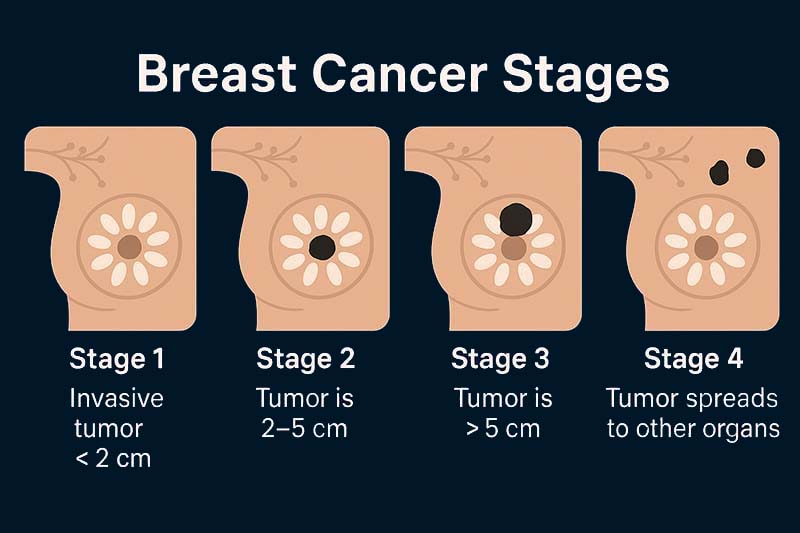
- Stage IA: The tumor is 2 cm or less in size, and there has been no spread to the lymph nodes.
- Stage IB: There is no tumor in the breast or the tumor is ≤ 2 cm, but small groups of cancer cells (micrometastases) have been detected in 1–3 lymph nodes.
Symptoms
Some patients can actually feel a small, painless lump during a self-exam at this stage. A few might notice a slight change in size or shape of the breast. Nipple changes are rare; for example, in some cases, the nipple may be tender or a little discharge may be seen, but in most instances, the cancer is detected on a mammogram before the onset of symptoms.
Diagnosis Tools
- Physical exam: To locate small lumps by feeling the breast.
- Mammogram and ultrasound: Allows visualization of small tumors.
- Biopsy: Identifies cancer type, hormone receptor, and HER2 status.
Treatment Options
- Lumpectomy or mastectomy: Removal of the tumor surgically.
- Sentinel lymph node biopsy: To find out the place(s) of cancer spread.
- Radiation therapy: Generally advised after a lumpectomy to lessen the chances of cancer coming back.
- Hormone therapy: For hormone receptor-positive cancers, this therapy works by stopping estrogen from helping cancer to grow.
- Chemotherapy or targeted therapy: The doctors will decide to go ahead with these treatments in case the tumor is fast-growing, HER2-positive, or the patient is high-risk.
Case Example
A 50-year-old woman finds a small lump while taking a shower. Upon testing, Stage IA invasive ductal carcinoma was confirmed. She goes through a lumpectomy, complemented with radiotherapy, and starts hormone therapy for 5 years. With the treatment, her prognosis is very good, with survival close to 100%.
Stage II Breast Cancer (Localized Spread)
What It Means
Stage II breast cancer is the next step after stage I. It refers to a growing tumor which is either 2 – 5 cm in size and there are no lymph nodes affected or there is a tumor ≤ 2 cm and 1 – 3 lymph nodes are involved. The cancer has not reached any distant organs but the lymph nodes in the area have been infected by cancer cells. Usually the treatment in this case is a mixture of therapies.
Subcategories
- Stage IIA: Tumor size less than or equal to 2 cm with 1–3 lymph nodes involved, OR tumor size between 2–5 cm with no lymph node spread.
- Stage IIB: Tumor size between 2 and 5 cm with lymph node involvement, OR tumor size more than 5 cm with no lymph node spread.
Symptoms
In the breast or the armpit, a developed lump can be felt in most cases. Swelling, nipple inversion, or secretion may be present. A few of the women state that the breast skin has changed in texture and that they have constant pain in the breast.
Diagnosis Tools
- Imaging: It sets the size and the spread of the tumor through mammogram, ultrasound, and MRI.
- Biopsy: Tells the stage of cancer and the cancer biology.
- Sentinel node biopsy/axillary dissection: It is used for checking whether the cancer has spread to the lymph nodes.
Treatment Options
- Surgery: Lumpectomy or removal of the breast, frequently combined with the removal of lymph nodes
- Chemotherapy: In some cases, it is administered pre-surgery to reduce the size of the tumor, or post-surgery to stop recurrence
- Radiation therapy: Aims at the breast as well as the close lymph node regions
- Hormone therapy: Administered when the cancer is hormone-dependent
- Targeted therapy: Applies to HER2-positive cancers (innovative treatments that stop cancer cells from growing)
Case Example
A 46-year-old woman was found to have a 3.5 cm tumor with 2 lymph nodes positive. She is given chemotherapy before surgery to shrink the tumor, then removed the breast and had radiation. She has been cancer-free since, with regular check-ups, for seven years.
Stage III Breast Cancer (Locally Advanced)
Stage III breast cancer is the term for cancer that is locally advanced. It indicates the mass to be very large, lymph nodes to be severely affected, or the cancer to have gone beyond the chest wall or skin. Although it is not metastatic, it still demands aggressive, multimodal treatment.
Subcategories
- Stage IIIA: Any size tumor with lymph nodes having 4–9 metastases.
- Stage IIIB: The tumor has become a part of the chest wall or skin and is causing swelling or ulcers.
- Stage IIIC: The cancer has reached lymph nodes more than 10 or nodes near the collarbone.
Symptoms
Some of the common signs are redness, swelling, thickening of skin, nipple inversion, or an appearance of the skin resembling an orange peel (peau d’orange). One may be able to feel the enlarged lymph nodes close to the collarbone or armpit.
Diagnosis Tools
- MRI or PET-CT scans: These give detailed pictures of the body.
- Biopsy of the lymph nodes: Confirms that the cancer has spread.
- Blood tests: Determine the functioning of organs before a very hard treatment.
Treatment Options
- Neoadjuvant chemotherapy: Typically administered first to reduce tumor size.
- Surgery: Most times a removal of the breast with the lymph nodes.
- Radiation therapy: Targets the breast, chest wall, and lymph node areas.
- Hormone & targeted therapies: Started as long-term treatments.
- Clinical trials: Usually suggested for advanced disease.
Case Example
A 38-year-old female came in with a painful lump, breast swelling, and skin dimpling. She was diagnosed with Stage IIIB breast cancer. After neoadjuvant chemotherapy, mastectomy, and radiation, she commenced an immunotherapy trial. At present, three years after diagnosis, she is cancer-free.
Stage IV Breast Cancer (Metastatic)
Metastatic breast cancer is the term used for stage IV breast cancer. It refers to the condition where the cancer, besides the breast and the lymph nodes, has spread to far-off body parts like the lungs, liver, bones, or brain. This stage is not curable; however, the disease can be managed by therapies for a long time.
Symptoms
The symptoms will be different depending on the area of cancer that has spread. Metastases to the bones cause bone pain and broken bones. Metastases to the lungs lead to cough and shortness of breath. Metastases to the liver cause jaundice, vomiting, and pain. Metastases to the brain may result in headache, dizziness, or convulsions.
Diagnosis Tools
- PET-CT or bone scans: Identify metastases in distant organs.
- MRI of the brain or liver: For a more accurate detection of the target area.
- Biopsy of metastatic sites: Identifies the cancer as originating from the breast.
Treatment Options
- Hormone therapy: This treatment is used when the cancer is a result of certain hormones.
- Chemotherapy: Mainly used for quickly growing or non-responsive cancers.
- Targeted therapy: The group includes drugs that antagonize HER2 as well as the drugs of the newer generation that stop cancer cells from mending themselves, and the immunotherapy that helps the immune system to fight cancer.
- Palliative care: Concentrates on making life good with the least possible discomfort.
Case Example
A 55-year-old woman is diagnosed with Stage IV breast cancer with bone and liver metastases. She starts HER2-targeted therapy along with hormone therapy. Five years later, her disease is stable, and she continues to enjoy an active lifestyle with regular monitoring.
Survival Rates by Stage (American Cancer Society 2024 Data)
- Stage 0 or I: Nearly 100%
- Stage II: Around 90%
- Stage III: Around 72%
- Stage IV: Around 29%
It is very much dependent on the biological nature of the tumor, the overall health state of the patient, and how well the treatment is responded to. In particular, the survival rates are still getting better with the use of targeted therapies and the ongoing clinical trials.