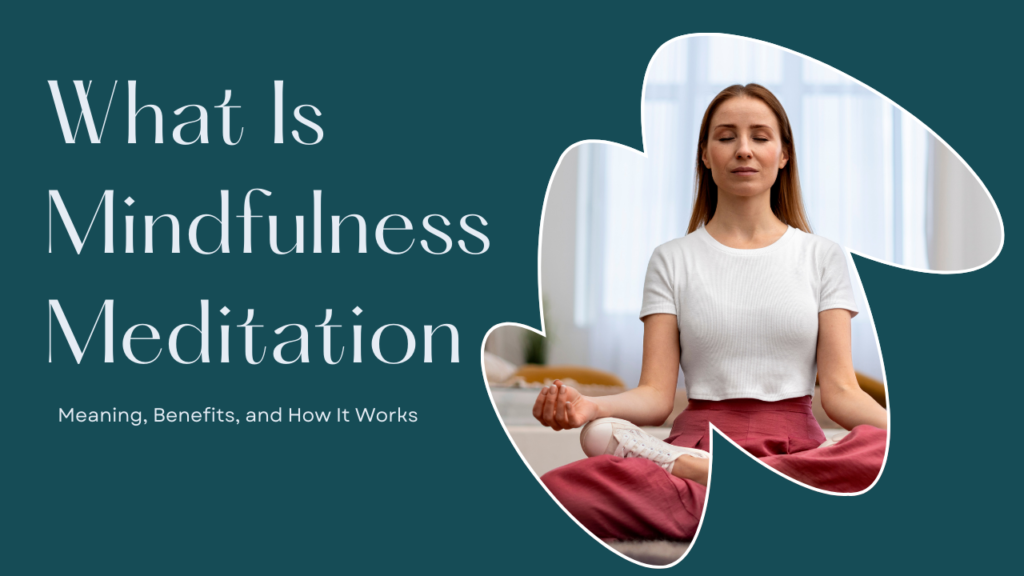
Mindfulness meditation is a mental practice that involves focusing your attention on the present moment with openness and without judgment. It trains the mind to observe thoughts, emotions, and physical sensations as they arise, rather than reacting automatically. Over time, this practice improves emotional regulation, reduces stress, and strengthens mental clarity.
Mindfulness meditation is nowadays one of the most popular mental health techniques that is practiced worldwide. Due to the advancement of industrialization, people are getting more and more stressed and anxious, thus many people are willing to find a good and reliable way to give them more peace and get control over their emotional balance. The first step to start benefiting from mindfulness meditation is knowing what it really is.
Basically, mindfulness meditation is about directing one’s attention deliberately in an open and curious way without judgment to the here and now. Instead of rejecting thoughts or trying to get rid of emotions, mindfulness instructors teach students to see their thoughts and feelings both from within and from outside as if they were a totally separate and different matter. Simply by changing one’s focus, one’s reaction to stress, anxiety, and the problems of everyday life can undergo a big transformation.
Mindfulness meditation is not a religious practice, nor is it a mystical kind of mentality. It is simply a mental workout that has been proven to work through brain science, psychology, and clinical trials. By regularly practicing over a long period of time, thought patterns will be changed for the better, one will be able to handle their emotions more effectively and be less affected by stressful situations.
The Meaning of Mindfulness Meditation
Mindfulness meditation can be better understood if you look at the two major components that compose it: mindfulness and meditation.
Mindfulness is being aware of the present moment. It is the act of focusing on the present moment and what is happening inside and outside of you, without judging the experiences as good or bad. Meditation here is the intentional exercisethat leads to this awareness.
Mindfulness meditation is a practice where you focus in on your breathing, the sensation of your body, or the sounds during a quiet solo sitting. Attention is diverted from the past or future in the form of thoughts when the mind really gets carried away, and then it is gently brought back to the present. This seemingly endless cycle of anchoring your attention to the here and now not only trains your mind but also keeps you grounded.
People often think that meditation is about emptying the mind or reaching a permanent state of tranquility. However, reality is far from this. Your thoughts will still come and go, your feelings will still vary, yet by getting aware of them and not attaching to them, you are actually meditating. Over time, your brain will get so used to this non-judgmental awareness that it will be less reactive to stress and emotional upheavals.
The Origins and Modern Evolution of Mindfulness Meditation
Mindfulness meditation initially comes from ancient contemplative traditions, especially Buddhist practices that focused on awareness and understanding. Yet, nowadays, mindfulness has been turned into secular, evidence-based programs that concentrate on mental health and stress management.
Among the present-day great influences is Mindfulness-Based Stress Reduction, a highly structured program designed to assist individuals in coping with chronic stress, pain, and anxiety. With the use of clinical applications and research, mindfulness meditation has become a part of therapy, corporate wellness programs, educational systems, and healthcare settings on a large scale.
Today, mindfulness is recognized not only as a spiritual discipline but also as a scientifically validated method for improving psychological well-being and nervous system regulation.
How Mindfulness Meditation Works in the Brain
One has to explore the brain’s stressresponse to really understand how mindfulness meditation operates. When the brain interprets something as a threat, it triggers the fight-or-flight system and releases stress hormones like cortisol and adrenaline. The stress response is good for helping us in the short term, but when it is constantly activated, it results in anxiety, emotional reactivity, and physical tension.
Mindfulness meditation breaks the chain of stress that goes on automatically in the brain. Studies have shown that long-term meditators have a thicker prefrontal cortex, which is the part of the brain that allows us to decide, focus, and regulate our emotions. In addition, the amygdala, which is our brain’s emotional center that causes fear, gradually becomes less reactive to stress.
Participants of mindfulness training are neurologically instructed to choose paths leading to emotional clarity when confronted with difficult situations rather than simply reacting to them. They are trusted to remain grounded and view their thoughts and feelings with a sense of detachment instead of being influenced by the flood of their minds and emotions.
Moreover, mindfulness turns on the parasympathetic nervous system – the component of the nervous system that calms the body (relaxation response). Breathing becomes deeper, heart rate lowers, and muscles relax. Such physiological effects lead to a pleasant sensation of being calm and in control that is very common among meditators.
The Key Benefits of Mindfulness Meditation
Mindfulness meditation has multiple benefits besides just providing momentary relaxation. One of the major benefits is efficient handling of stress. Since mindfulness increases awareness of our thoughts and emotions, it enables our minds to discover the causes of our stress much more quickly and thus behave in a more conscious way.
Another significant advantage is a decrease in anxiety. Anxiety is a state of mind that is often caused by fear of the future, so when your attention is focused on the present moment, it is you who reduces mental overactivity. Many people state that they think more clearly and that their concentration is better when they have practiced mindfulness on a regular basis.
Another important aspect is that mindfulness meditation facilitates emotion regulation. Rather than ignoring feelings or overreacting, the person discovers that he can notice the emotions without necessarily judging them. This kind of skill is what makes the person stronger in the face of difficulties and also leads to better relationships.
Mindfulness practice is often followed by improvement in sleep as well. When mindfulness is practiced, it helps the nervous system to relax and the mind to stop thinking over and over the same things, and this is exactly what makes it possible to sleep better and more deeply. After a while, the changes that you have made will result in you becoming emotionally more balanced and mentally more alert.
What’s more, mindfulness raises the level of self-awareness. The clearer individuals see their thoughts, the more they understand the habitual nature of their thinking patterns. Such understanding brings about awareness not only of oneself but also of one’s personal choices.
What Happens During a Mindfulness Meditation Session
A typical mindfulness meditation session will start by seating oneself comfortably. The eyes might be gently closed, and focus shifted to one’s breathing. The primary concentration is on the breath going in and out.
Within a few seconds, the brain naturally drifts off. The mind starts thinking about different things, like the tasks to be done, past events, and worries. Instead of fighting against such thoughts, the meditator just recognizes them and lightly brings the focus back to the breathing. This going back and forth between the two activities is the core of mindfulness practice.
Slowly, mind stability is regained. The meditator gets the ability to notice distractions without following them. Even a brief session of five to ten minutes may slowly develop one’s ability to focus and keep his/her emotions in check.
Mindfulness meditation can be mixed with body awareness exercisesas well. Here, the focus is changed from one body part to another, and the sensations in each part are observed without any intention to alter them. Hence, the mind and body get more and more connected.
Common Misunderstandings About Mindfulness Meditation
A common misconception is that mindfulness meditation is about getting rid of thoughts. However, thinking is a natural activity of the brain, and it is not possible to suppress thoughts completely. The aim is to change the way you relate to your thoughts, not to get rid of them.
It is also wrongly believed that only people with a calm disposition can benefit from mindfulness. Actually, people who are often stressed, anxious, or emotionally upset can get great benefits from mindfulness. The emphasis of the practice is not on being perfect but on growing awareness.
Some think that to be effective, mindfulness must be practised in long sessions. It is true that long practice eventually leads to greater benefits, but even short daily sessions, if done regularly, can effect significant changes.
How to Start Practicing Mindfulness Meditation
Starting out with mindfulness exercises, you don’t really need special stuff or a fancy place. Just a quiet corner and a handful of minutes free from distractions are enough. It’s good to start with brief practices and then slowly extend the time to get used to it.
The main point of mindfulness meditation is having lots of patience. Changes come little by little, and mostly you don’t even notice them. Rather than using the peaceful state of mind as the success criteria, it’s more agreeable if you define success as the act of returning your attention to the present moment over and over again.
Having a fixed timetable helps to cement the whole thing as a habit. Doing it in the morning, you can get a balanced vibe going for the whole day, whereas practicing at night, you are encouraging your body for a good relaxation and recovery cycle.
Why Mindfulness Meditation Matters in Modern Life
The ability to stay present has become a rare commodity in a world full of constant stimulation and digital distractions. Mindfulness meditation is one of the ways of dealing with this problem. It allows individuals to regain command over their thoughts by focusing and becoming emotionally aware.
Just knowing a definition of mindfulness meditation does not mean one understands it. It is a matter of seeing its power to change lives. If you practice it regularly, mindfulness is not just a method but it changes your relationship with the mind and the things you notice, understand, and feel.
Regularly practicing mindfulness meditation fosters mental resilience, emotional stability, and an enriched sense of well-being. While the body of evidence is still growing, the implications of mindfulness for personal growth and clinical psychology are obvious.
Mindfulness meditation is essentially a shift back to the here and now. When you are there, stress is no longer your master, your awareness grows, and a more stable way of living becomes feasible.