
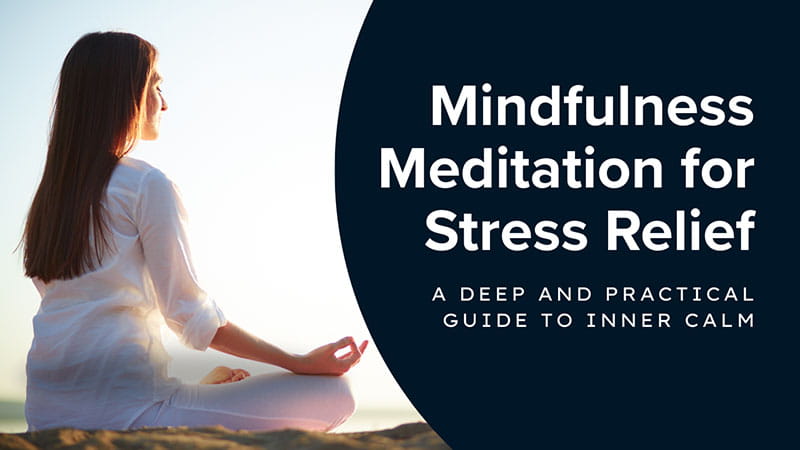
Mindfulness Meditation for Stress Relief: A Deep and Practical Guide to Inner Calm
Stress is a part of life that we cannot avoid nowadays. Anxiety from different sources, such as continuous disturbances, work-related stress, uncertain financial situations, and emotional burdens, keeps the brain in a state of heightened alertness.
Eventually, the pressure not only reduces the ability to think clearly but it also impacts emotional stability and physical well-being. Some people turn to diversion activities to get rid of stress, however, genuine relief is achieved when one understands how the brain operates under pressure. Mindfulness meditation is one of the most efficient methods that have been validated by scientific studies.
Stress is so overpowering that it feels hard to cope when, in fact, one of the reasons is overlooking the close connection between chronic stress and mental health. If the pressure is forced down or neglected, the whole frame of mind, emotional impulses, and even the biological nervous system will be changed over time without the person realizing it. Mindfulness meditation offers a way to break this cycle by teaching the mind how to remain present, calm, and aware.
What Is Mindfulness Meditation?
Mindfulness meditation is a practice where one focuses on the here and now with a receptive and non-judgmental attitude. It basically means looking at what’s going on inside your thoughts, emotions, and physical sensations without trying to change or push them away. Actually, there’s no rule saying that you shouldn’t think; instead, it is about becoming conscious of your thoughts.
Initially, mindfulness might seem strange because the brain is used to constant movement. However, once the basic idea is understood, the practice becomes simple and accessible. Those who want to understand the basics thoroughly can benefit from reading about what is mindfulness meditation and how the interplay between awareness and presence leads to less mental clutter.
Mindfulness allows one to experience brain changes which help in observing rather than reacting emotionally. It is at these moments of inner turmoil, like stress, anxiety, and emotional overload, that the acquired skill of mindfulness becomes very resourceful.
Why Stress Happens (And Why Mindfulness Works)
Stress turns on the body’s fight-or-flight response, which was a mechanism of protection from the predatory attacks of our ancestors. When this response is activated over and over again by the everyday pressures, the body never really gets time to relax. The stress hormones stay at a high level, the breathing becomes shallow, and the brain remains on a high alert even when there is no danger.
This incessant triggering of the system gradually leads to an impact on sleep, digestion, mood, and concentration. For most people, anxiety usually comes with stress. So it becomes important to understand meditation for anxiety and stress since stress is not a psychological issue only, but a complete body reaction which needs to be calmed down at the nervous-system level.
Mindfulness meditation counteracts the stress reaction by comforting the brain that it is safe, thus making the body relax and be in a calmer state.
The Science Behind Mindfulness and Stress Relief
Scientific investigations have demonstrated that mindfulness meditation brings about quantifiable changes in the brain. The areas that regulate emotions, attention, and self-awareness become more potent, whereas the parts of the brain that deal with fear and stress reactivity become less influential.
Numerous experiments have shown that mindfulness meditation, supported by scientific evidence, helps to lower cortisol levels, maintain better emotional control, and increase mental clarity. These transformations are the reasons that mental health professionals widely recommend mindfulness as a complementary tool for managing stress.
Instead of suppressing stress, mindfulness changes the brain’s stress response, thus creating a new brain pattern for resilience that can last a lifetime rather than a temporary reprieve.
How Mindfulness Meditation Reduces Stress in Daily Life
Mindfulness meditation for stress relief operates by aborting the automatic reactions to stress. Mindfulness, instead of allowing a person to instantly react to a stressful thought, brings about a break during which awareness is substituted for panic, and the capacity to choose is substituted for a reaction.
When attention remains firmly placed on the present moment, the nervous system gradually moves away from the survival mode. Breathing becomes slower, muscles relax, and thoughts do not have their usual emotional impact. This is the reason why mindfulness meditation for stress relief is effective not only inside meditation sessions but also in daily scenarios such as dealing with pressure at work, having a difficult conversation, or facing an unexpected challenge.
Eventually, with consistent sessions, moments of stress do not overwhelm the whole mind anymore.
Different Forms of Mindfulness Meditation
Mindfulness meditation, in fact, is a versatile practice that can be adapted to different tastes and conditions. The most breath-conscious meditation is recommended as the first step because breathing plays a significant role in the nervous system. One becomes more present in the moment with the simple act of following each breath in and out.
On top of that, one of the workout areas is the body–or more specifically, a person’s experience of physical sensations. Combining mindfulness with deep breathing techniques for relaxation enhances stress reduction by calming both the mind and the body simultaneously.
In fact, you can practice mindfulness by being mindful when you move, walk, or do your everyday tasks, which makes it very convenient even for people with tight schedules.
How to Practice Mindfulness Meditation Effectively
The key to effective mindfulness meditation lies in regularity, not in achieving a flawless state. The crux of the practice is to have a relaxed posture, keep your focus on breathing, and when your attention drifts, kindly bring it back to the breath.
When mindfulness is not a one-off thing but a habitual practice, change becomes more evident. Doing daily mindfulness practice routine is a form of mental conditioning that, over time, aids your mind in catching signs of stress sooner and thus shifting to a calm awareness instead of alarm.
Eventually, mindfulness becomes so ingrained in your lifestyle that it is not limited to the times you meditate, and it serves you in managing your thoughts and emotions throughout the day.
Building a Sustainable Mindfulness Habit
Mindfulness meditation can only be really powerful if it becomes a habit rather than a one-off technique. Our brain will be more engaged if we practice at the same time each day. If you do meditation early in the morning, it will help you to stay calm during the day, and if you do it at night, it will help you relax and recover.
One significant long-term advantage of keeping the habit is the quality of sleep. With regular mindfulness practice, people sleep deeply, and indeed, as a result of practicing mindfulness meditation for better sleep, most individuals notice their sleep quality dramatically improving, which in turn reduces their stress level even more.
You can build a sustainable practice by being patient with yourself, showing yourself kindness, and having realistic expectations.
Common Challenges and Misunderstandings
One common misconception regarding mindfulness meditation is people thinking that the mind has to be totally quiet. Actually, it is normal that thoughts come up. The main idea of the practice is not to get rid of them but to alter your attitude towards them.
Being unfocused or fidgety during meditation doesn’t mean that you have failed. Those situations are a chance to learn how to control your emotions through mindfulness, which becomes easier as you increase the time and effort you put into it. When you stop judging yourself, you transform mindfulness into a healing and supporting practice instead of turning it into a source of pressure.
Mindfulness Meditation in a Busy World
It is not necessary to disengage from the world of one’s responsibilities or set aside time during the day for two or more hours in order to practice mindfulness. Actually, it can be realized in short instances during the day. One’s habit of being mindful can be enhanced by doing breath awareness before a meeting, next being mindful of all the senses while walking, or simply being present for a few seconds before one goes to bed.
Such small moments add up, eventually changing the way one experiences stress. Life does not get easier, but the inner reaction to it becomes calmer and more balanced.
Long-Term Impact of Mindfulness on Mental Well-Being
Continuous practice of mindfulness meditation completely transforms how you handle stress. Instead of going amok, emotions calm down, you become more resilient, and your mind frees up for more clarity. Some people have communicated that after practicing this method regularly, they have felt more grounded, patient, and emotionally steady even when faced with difficulties.
Besides, mindfulness raises your level of self-awareness, which is very helpful in recognizing stress symptoms when they just begin to develop. Being aware at this stage helps you take care of yourself beforehand instead of waiting till you are highly stressed to find relief.
Final Reflection: Why Mindfulness Meditation Truly Matters
Mindfulness meditation does not make your life entirely stress-free. What it does is change how you experience stress. Rather than being overwhelmed by pressure, your thoughts or feelings, mindfulness gives you a feeling of inner balance and clarity.
Basically, mindfulness meditation to relieve stress is more than just a method; it is a deep change in one’s level of awareness. With regular practice, it can foster emotional strength, a peaceful mind, and an improved way of dealing with everyday problems.
Mindfulness is a very simple and effective practice that helps people in a world of fast lifestyle to find peace in the present moment and have authority over their inner state of well-being.
Related Articles



If you are new to mindfulness meditation, the most important thing to remember is to keep your practice simple and consistent. You do not need to clear your mind or stop your thoughts completely. Instead, focus on your breathing and gently bring your attention back whenever your mind wanders. Even practicing for just a few minutes each day can create meaningful changes over time, helping you feel calmer and more in control of your thoughts.